

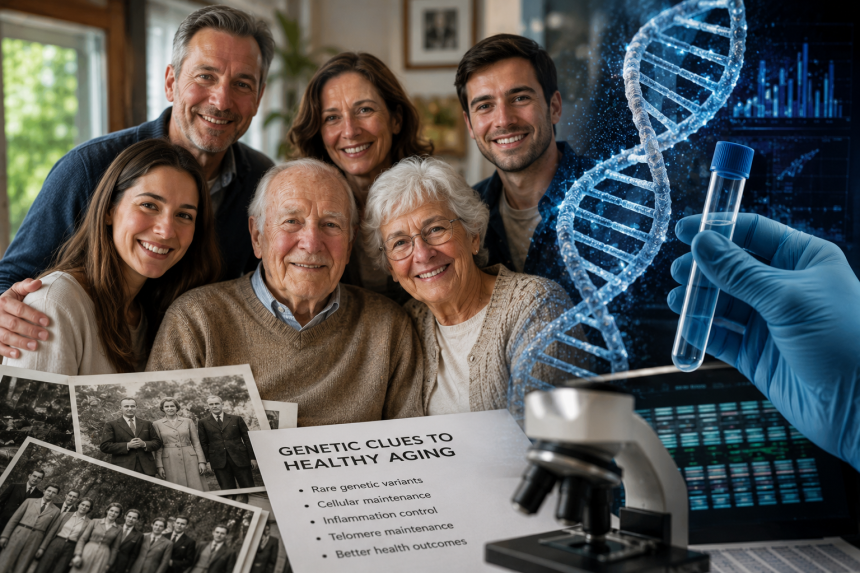
For centuries, people have searched for the secret to a longer and healthier life. While better healthcare, nutrition, and living conditions have helped increase life expectancy, one important question remains unanswered: why do some people stay healthy well into old age while others develop chronic diseases much earlier?
- Why Healthy Aging Matters More Than Ever: Healthy Aging Gene
- Long-Lived Families Hold Valuable Clues: Healthy Aging Gene
- Scientists Analyzed Hundreds of Aging-Related Genes: Healthy Aging Gene
- One Gene Stood Out From the Rest: Healthy Aging Gene
- Inflammation May Be a Key Piece of the Puzzle: Healthy Aging Gene
- Better Heart Health Appears Linked to Longevity
- Genetics Is Not the Whole Story
- Small Protective Effects Add Up
- Why This Research Matters
- Final Thoughts
A new study may have brought scientists one step closer to the answer. Researchers studying families known for exceptional longevity have identified a rare Healthy Aging Gene clue that could help explain why some individuals enjoy longer lives with fewer age-related health problems.
Presented at the annual conference of the European Society of Human Genetics in Gothenburg, the research suggests that rare genetic variants found in long-lived families may play an important role in supporting healthy aging and extending healthspan.
The findings are generating excitement among scientists because they offer fresh insights into the biological processes that help people remain healthier for longer periods of time.
Why Healthy Aging Matters More Than Ever: Healthy Aging Gene
People today are living much longer than previous generations.
Over the last two centuries, life expectancy has increased dramatically across many parts of the world. However, the number of years spent in good health has not increased at the same rate.
This means many people spend their later years dealing with chronic illnesses, reduced mobility, and cognitive decline.
Researchers are increasingly focused on understanding healthspan rather than lifespan alone.
What Is Healthspan?
Healthspan refers to the number of years a person lives free from major chronic diseases and significant cognitive decline.
While lifespan measures total years lived, healthspan focuses on quality of life.
The goal is not simply to live longer but to remain healthier for longer.
This is where the search for a Healthy Aging Gene becomes especially important.
Long-Lived Families Hold Valuable Clues: Healthy Aging Gene
Scientists have known for many years that longevity often runs in families.
People from long-lived families frequently experience a later onset of common age-related diseases compared to the general population.
However, identifying the specific genetic factors responsible has proven challenging.
To better understand these patterns, researchers analyzed families participating in the Leiden Longevity Study, one of the world’s most important investigations into healthy aging.
Looking Beyond Common Genetics
Most genetic studies focus on variants commonly found throughout the population.
This research took a different approach.
Instead of searching for widespread genetic markers, scientists focused on rare family-specific variants that might provide stronger protection against aging-related decline.
The study suggests these rare variations may offer important clues about the biological foundations of longevity.
Scientists Analyzed Hundreds of Aging-Related Genes: Healthy Aging Gene
The research team examined the genomes of 212 groups of long-lived siblings, often referred to as sibships.
These individuals came from families known for exceptional longevity.
Researchers analyzed hundreds of genes previously associated with aging and disease.
What They Found
The study identified several rare genetic variants involved in:
- Cellular maintenance
- Aging pathways
- Inflammation control
- DNA repair
- Metabolic stability
Many of these variants appeared to support biological processes associated with healthier aging.
The discovery strengthens the idea that a Healthy Aging Gene may not be a single gene but rather a collection of protective genetic factors working together.
One Gene Stood Out From the Rest: Healthy Aging Gene
Among the many findings, one particular genetic variant attracted significant attention.
Researchers identified a rare variation in OBFC1, a gene involved in maintaining telomeres.
Why Telomeres Matter
Telomeres are protective structures located at the ends of chromosomes.
They help preserve genetic information during cell division.
As people age, telomeres gradually shorten, which has been linked to aging and disease development.
The rare OBFC1 variant discovered in the study appeared repeatedly in long-lived families.
Researchers believe it may help maintain genomic stability for a longer period of time, potentially supporting healthier aging.
This finding makes OBFC1 one of the most interesting candidates in the search for a Healthy Aging Gene.
Inflammation May Be a Key Piece of the Puzzle: Healthy Aging Gene
Another important finding involved inflammation.
Scientists identified a mutation that appears to reduce inflammatory activity within the body.
Why Lower Inflammation Matters
Chronic inflammation has been linked to numerous age-related conditions, including:
- Cardiovascular disease
- Diabetes
- Neurodegenerative disorders
- Certain cancers
Reducing inflammation may help delay disease onset and preserve health for longer periods.
Researchers believe this protective effect could contribute to the remarkable longevity observed in certain families.
The connection between inflammation control and the Healthy Aging Gene theory continues to attract growing scientific interest.
Better Heart Health Appears Linked to Longevity
The study also revealed associations between specific genetic variants and healthier cardiovascular outcomes.
Individuals carrying certain protective variants demonstrated several positive health indicators.
Health Benefits Observed
Researchers reported links to:
- Better cardiovascular profiles.
- Healthier cholesterol levels.
- Lower blood pressure.
- Slower biological aging markers.
These findings suggest that genetics may help create favorable conditions that support long-term health.
However, scientists emphasize that genetics is only one part of the equation.
Genetics Is Not the Whole Story
Although the research highlights the importance of rare genetic variants, scientists caution against viewing genetics as destiny.
Longevity is influenced by many factors beyond inherited DNA.
Other Factors That Shape Aging
Researchers note that healthy aging is also affected by:
- Lifestyle choices
- Physical activity
- Diet
- Environmental factors
- Socioeconomic conditions
- Access to healthcare
As a result, not everyone from a long-lived family will automatically enjoy exceptional longevity.
Likewise, individuals from average families may still live very long and healthy lives.
The Healthy Aging Gene may provide an advantage, but it is only one piece of a much larger picture.
Small Protective Effects Add Up
One of the most interesting conclusions from the study is that healthy aging likely results from many small protective effects working together.
Rather than relying on one powerful mutation, long-lived families appear to benefit from combinations of rare genetic variants.
A Network of Protection
These protective effects seem to influence:
- DNA repair mechanisms.
- Inflammation regulation.
- Cellular maintenance.
- Stress-response pathways.
- Metabolic stability.
- Telomere maintenance.
Researchers believe this network of biological protections helps explain why some individuals remain healthier for longer periods.
The findings suggest the search for a Healthy Aging Gene may actually involve understanding entire systems rather than isolated genes.
Why This Research Matters
The study offers valuable insights into one of medicine’s biggest challenges.
As populations age worldwide, understanding how to extend healthspan becomes increasingly important.
Researchers hope these discoveries may eventually contribute to new strategies aimed at preventing age-related diseases and improving quality of life.
Future Research Will Continue
The work was led by Mr. Pasquale Putter, a final-year PhD student in Professor Eline Slagboom’s group at Leiden University Medical Center.
Scientists plan to continue investigating rare genetic variants in long-lived families to better understand the mechanisms behind healthy aging.
Future studies may reveal additional pathways that contribute to exceptional longevity.
Final Thoughts
The latest Healthy Aging Gene research provides a fascinating glimpse into why some people remain healthier and live longer than others. By studying 212 groups of long-lived siblings, researchers identified rare genetic variants linked to inflammation control, cellular maintenance, DNA repair, cardiovascular health, and telomere stability.
Among the most significant discoveries was a rare variant in OBFC1, a gene involved in telomere maintenance that may help support genomic stability and healthy aging. At the same time, the study reinforces an important message: longevity is influenced by both genetics and lifestyle factors.
While scientists continue exploring the complex biology of aging, these findings bring researchers one step closer to understanding how healthier, longer lives may be achieved for future generations.
Read Other Interesting news here: Vaping Cancer Risk
